If you have been researching garage floor coatings, you have probably run into the same internet shouting match a thousand times. One side claims polyaspartic is the only product worth installing. The other side says polyaspartic is overhyped and epoxy still wins on durability. Both sides are pushing whatever the contractor selling the article happens to install.
The real answer is neither. The right floor for your Charlotte garage is not epoxy versus polyaspartic. It is epoxy AND polyaspartic, working together, in the configuration that fits your specific environment.
This guide cuts through the marketing noise. You are going to learn what each material actually does, where each one belongs in a real coating system, and why the most professional flake garage floors in Charlotte use both materials together by design. By the end, you will know exactly what to ask any contractor pitching you a coating job.
The Marketing Trap Most Homeowners Fall Into
Every coatings contractor leans on one product and tries to convince you it is the best. That is not because the product is actually superior across the board. It is because the contractor wants to sell what they install.
Polyaspartic-only contractors talk about UV stability and fast cure times. Epoxy-only contractors talk about bond strength and durability. Both groups oversimplify the science to make their pitch easier.
The truth is that polyaspartic and epoxy each have specific strengths. They also each have specific limitations. A floor that takes advantage of both materials in the right places gives you a system that outperforms either material on its own. That is how a professional flake garage floor is actually built.
What Epoxy Actually Does Well
Epoxy is a thick, two-component coating that bonds deeply with concrete. It is a commercial-grade product used in industrial settings for decades and now widely in residential garages, basements, and workshops.
Strongest bond to concrete
Epoxy cures slowly compared to other coatings. That slow cure gives it time to penetrate deep into the pores of the concrete. The chemical bond it creates is stronger than what polyaspartic produces when used as a base coat.
Thicker, tougher base layer
Epoxy applies in a thicker layer than polyaspartic. That thickness contributes to overall durability. The base of your floor is denser, more impact-resistant, and provides a more substantial foundation for everything above it.
Built-in moisture tolerance
Most epoxy formulations include a built-in moisture barrier. That makes it more tolerant of slabs with some moisture present without requiring an extra moisture vapor barrier layer first. For garages where slab moisture is unknown or potentially elevated, that built-in tolerance is a real advantage.
Where epoxy falls short
Epoxy yellows when exposed to direct sunlight over time. That makes it a poor choice for outdoor patios, driveways, and pool decks where UV exposure is constant. It also has a longer cure time than polyaspartic, which makes it more demanding for crews on one-day systems.
For a Charlotte garage with no direct sunlight on the floor, those limitations do not matter. The interior environment plays directly to epoxy’s strengths.
What Polyaspartic Actually Does Well
Polyaspartic is a fast-curing, UV-stable coating that is extremely scratch-resistant. It is widely used in both residential and commercial applications.
Highest UV stability of the three coating materials
Polyaspartic does not amber under direct sunlight. That makes it the right choice for any layer that will be exposed to UV. For an indoor garage floor, the top coat sees minimal UV, but the polyaspartic top coat keeps the finish looking the same year after year regardless of light exposure.
Most scratch-resistant material
Polyaspartic resists scratches better than epoxy or polyurea. For a top coat that handles daily traffic, dropped tools, dragged equipment, and vehicle tires, that scratch resistance is exactly what you want sealing the floor.
Fastest cure time
Polyaspartic cures very quickly. Walk-on times are typically 4 to 6 hours after application. Drive-on times are typically 12 to 24 hours. That fast cure is what makes single-day installations possible.
Where polyaspartic falls short
Because polyaspartic cures so fast, it does not have as much time to penetrate concrete pores as epoxy does. Its bond to bare concrete as a base coat is not as strong as epoxy’s. It is also thinner than epoxy and does not include a built-in moisture barrier. If a slab has moisture issues and a contractor uses polyaspartic as a base coat, an additional moisture vapor barrier layer may be required first.
The Honest Comparison Most Articles Get Wrong
Here is where most online articles fall apart. They make claims like “polyaspartic has 90% solids and epoxy only has 40 to 60%.” That is false. They claim polyaspartic is universally stronger than epoxy. False. They claim epoxy yellows in six months. The actual timeline depends on UV exposure and varies significantly. They claim epoxy is the budget option. Also false.
The real comparison is environmental, not absolute.
For an indoor Charlotte garage floor
Epoxy as the base coat plus polyaspartic as the top coat is the most recommended combination. The epoxy delivers maximum bond strength and moisture protection. The polyaspartic top coat delivers UV stability and scratch resistance. The strongest possible floor with full protection.
For an outdoor patio, driveway, or pool deck
Polyaspartic on both layers. Because UV exposure is the primary concern outdoors, polyaspartic on both the base and the top coat is preferred. An epoxy base coat outdoors will eventually amber and affect the appearance of the finished floor.
For a slab in a cold-climate area with heavy freeze-thaw cycles
Polyurea as the base coat is the strongest choice because of its flexibility. It expands and contracts with the concrete without cracking. A polyaspartic top coat finishes and protects the system.
Universal rule for top coats
Regardless of what base coat is used, polyaspartic is almost always the right top coat. UV stable, scratch resistant, and the cleanest, most durable finish available.
The point is this. Polyaspartic is not better than epoxy. Epoxy is not better than polyaspartic. The right system uses both materials in the right places.
Why a Professional Flake Floor in Charlotte Uses Both
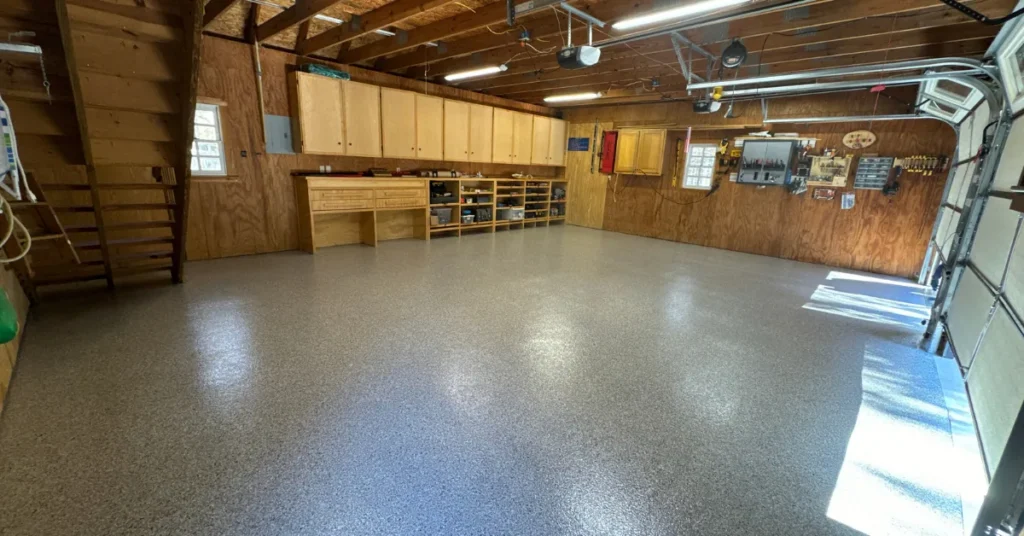
D&D Concrete Coatings installs decorative vinyl flake garage floor systems built around exactly this principle. The system uses a high-performance epoxy or polyurea base coat depending on the slab and environment, and a UV-stable polyaspartic top coat sealing everything together.
Here is why each layer is doing exactly what it should be doing.
The epoxy or polyurea base coat is selected for the slab. Epoxy where bond strength and moisture tolerance are priorities. Polyurea where flexibility and freeze-thaw performance matter. Either way, the base coat is doing the job a base coat is supposed to do: bonding deeply with the concrete and creating a strong foundation for the rest of the system.
The full-coverage vinyl flake broadcast adds visual depth, slip resistance, and additional thickness to the system. The flake is embedded into the wet base coat and locked in once the base coat cures.
The polyaspartic top coat seals everything. It is what your eyes see and what handles the daily abuse of garage life. UV-stable so it does not yellow. Scratch-resistant so it does not show wear from tools, tires, and traffic. Fast-curing so the floor is back in service in a single day.
That layered approach is not a marketing pitch. It is what a real coating system looks like when the contractor understands the materials and chooses the right one for each job.
What to Watch Out for in the Polyaspartic Marketing Push
Some contractors aggressively market polyaspartic-only systems as superior to anything that uses epoxy. Be cautious when you see this.
A polyaspartic-only system can be a great floor in the right environment, but it is not automatically better than a system that uses both materials. When polyaspartic is used as a base coat indoors on a slab with elevated moisture, the bond can be weaker and the moisture handling less robust than an epoxy base would have provided.
If a contractor pushes polyaspartic as a single-product solution for every situation, that is a sign they are selling what they install rather than recommending the right system for your floor. Ask them why they chose that material specifically for your slab and your environment. A good answer references the slab condition, the moisture level, and the UV exposure. A bad answer is just “polyaspartic is the best.”
The same goes the other direction. If a contractor pushes epoxy as a complete solution and skips the polyaspartic top coat, the finished floor will yellow over time and scratch more easily. Both materials have a job. The right contractor uses both correctly.
How D&D Approaches the Material Choice for Every Garage
When David Shindledecker assesses a garage floor in Charlotte, the material choice is not predetermined by marketing. It is determined by the slab.
A standard residential garage with no direct sunlight on the floor and average slab conditions gets an epoxy base coat for maximum bond strength and moisture handling. An older slab with elevated moisture readings might need a moisture vapor barrier first, then either base coat applied on top. A slab in a configuration where flexibility is a higher priority might call for polyurea as the base coat.
The polyaspartic top coat is the constant. UV-stable, scratch-resistant, fast-curing, and the standard for every flake floor D&D installs.
That is what professional installation looks like. The system is matched to your specific floor, not pulled off a shelf and rolled out the same way every time.
For full system specifics, color blends, and use cases, the flake garage floor service page walks through everything D&D installs and why.
What This Means When You Are Comparing Quotes
When you collect quotes from epoxy flooring contractors in Charlotte, here is what the material discussion should sound like.
A real professional will ask about your slab. They will look at the concrete, ask about water issues, ask about how you use the space, and recommend the right base coat for your specific situation. They will explain why they are using a polyaspartic top coat and what that buys you in terms of UV stability and scratch resistance.
A less experienced contractor will quote the same thing for every floor regardless of conditions. That is a sign they are running through a single-product playbook rather than fitting the system to your slab.
Use this as a filter. Ask every contractor what base coat they would use on your floor and why. Ask what top coat they use and what it does. The answers will tell you exactly how much they understand about what they are installing.
FAQ’s
Is polyaspartic actually better than epoxy?
Not as a blanket statement. Polyaspartic is more UV-stable and scratch-resistant. Epoxy bonds deeper and has better built-in moisture tolerance. The right system uses both materials in the right places. For an indoor Charlotte garage, that typically means an epoxy base coat with a polyaspartic top coat sealing everything.
Will an epoxy base coat yellow in my garage?
Not in a typical Charlotte garage. Epoxy yellowing is a problem when the epoxy is directly exposed to UV light. Inside a garage where the floor is not in direct sunlight, the epoxy base coat is sealed under a UV-stable polyaspartic top coat. The visible top layer is what handles UV exposure, and polyaspartic does not yellow.
Can I just install polyaspartic on its own and skip the epoxy?
You can, but it is not always the optimal choice for an indoor garage. Polyaspartic as a base coat does not bond as deeply to concrete as epoxy and does not include built-in moisture tolerance. For garages with elevated slab moisture, an epoxy base coat will deliver a stronger, more reliable system. For outdoor applications with full sun exposure, polyaspartic on both layers is the right choice.
How long does a polyaspartic top coat last on a flake floor?
A professionally installed flake system with a polyaspartic top coat will hold up for many years when properly maintained. D&D Concrete Coatings backs every flake garage floor with a 10-year warranty against delamination.
What is the difference between polyaspartic and polyurea?
Both are fast-curing coatings, but they have different strengths. Polyaspartic is more UV-stable and scratch-resistant, making it the standard top coat. Polyurea is more flexible and performs better in cold climates with freeze-thaw cycles, which is why it is sometimes used as a base coat. They do different jobs in a system.
Does the choice between epoxy and polyaspartic affect installation time?
It can. Polyaspartic cures faster than epoxy, which is what makes one-day installations possible. A typical flake garage floor with a polyaspartic top coat is walk-ready within 24 hours and drive-ready within 75 hours after final application. The material choice is one of several factors that determine the install timeline for any specific job.