Hiring the wrong epoxy flooring contractor is one of the most expensive mistakes a homeowner can make. The product can be top-grade, the marketing can be slick, the quote can be reasonable, and you can still end up with a floor that peels in eight months. Why? Because in this industry, the crew matters more than almost any other variable.
If you are searching for epoxy flooring contractors in Charlotte, you have probably already noticed how many options exist. Some pitch the lowest price. Some hide behind generic websites with stock photos. Some have been doing this for one season. Others have been doing it for years and still cut corners.
This guide walks you through exactly what separates a real professional from a low-quality competitor. By the end, you will know what to ask, what to look for, and how to spot a quality crew before you ever sign anything.
Why the Contractor Matters More Than the Product
Most homeowners assume the brand of epoxy or polyaspartic determines how their floor performs. That is partially true. The bigger truth is that the installer determines whether the product even gets a chance to perform.
A premium coating system installed badly will fail just as fast as a cheap kit. A mid-grade system installed correctly will outperform a premium system installed by a rushed, inexperienced crew. The chemistry, the working windows, the prep, and the application technique all sit in the hands of the people doing the work.
That is why the question is not “which product should I buy?” The question is “who is going to install it?”
The Most Common Reasons Coating Jobs Fail
Before you can evaluate a contractor, you need to understand what actually causes coating jobs to fail. Once you know what goes wrong, you will know exactly what to ask about.
Skipped or rushed surface preparation
Improper prep is the single biggest cause of coating failure. A slab that is not properly diamond ground will not bond with the base coat. The floor might look great for the first few months, then it starts peeling at edges or lifting under hot tires.
Missed moisture testing
Concrete holds moisture. If a contractor skips the moisture test and applies a base coat that cannot handle the slab’s moisture levels, the floor will eventually delaminate from the bottom up. By the time you see the bubbles or peeling, the bond is already gone underneath.
Wrong product for the environment
A polyaspartic-only system installed indoors when an epoxy base would have given a stronger bond. An epoxy base coat installed outdoors in direct sun, where it will amber within a couple of seasons. The right product depends on the environment, and an experienced contractor knows which one to use where.
Working past the chemical window
Every coating product has a working window. Once mixed, the crew has a limited amount of time to apply it before it starts to cure. A slow, disorganized, or inexperienced crew runs out of time. The result is uneven application, flake that does not embed properly, and visible inconsistencies across the floor.
Inconsistent flake broadcast
In flake systems, the flake must be broadcast to full coverage while the base coat is still wet. A contractor who under-broadcasts to save material leaves thin or patchy spots where the base coat shows through. This is one of the easiest signs of an amateur installation.
Visible roller marks and section lines
Roller marks in the top coat are a sign of poor application technique. Section lines mean the crew applied the floor in pieces instead of as one continuous installation. A truly professional install should look completely uniform from one end of the floor to the other, with no visible seams, lines, or marks.
What to Ask Every Epoxy Flooring Contractor Before You Hire Them
These questions will separate the pros from the rest of the field within five minutes.
Do you diamond grind the slab as part of every installation?
The answer should be yes, every time, no exceptions. If a contractor talks about acid etching, chemical prep, or “no prep needed” systems, walk away. Diamond grinding is the industry standard for a reason. Anything else is a shortcut that will cost you the floor.
Do you perform a moisture test before applying the base coat?
The answer should be yes. Moisture testing is not an upsell. It is a basic step in any professional installation. If they skip it, the floor’s lifespan is in the hands of luck.
What base coat will you use on my floor and why?
A real professional will explain the choice based on your environment. Garage with no direct sun? Epoxy base coat for the strongest bond and best moisture tolerance. Cold-climate or freeze-thaw concern? Polyurea for flexibility. Outdoor patio with full sun? Polyaspartic base for UV stability. If the answer is just “we use the same thing on everything,” that is a red flag.
What top coat do you use and is it UV-stable?
The answer should be polyaspartic. UV-stable, scratch-resistant, fast-curing, and the cleanest finish available. If they are pitching an epoxy top coat for an indoor garage with no UV concern, that can be acceptable in some specific systems, but it is uncommon in modern flake installations. Polyaspartic is the standard top coat across the industry.
Is the install completed in one day or two?
Both can be valid depending on the system. What matters is that the contractor has a clear, confident answer based on the products they use. D&D Concrete Coatings, for example, completes most residential garages in a single day with vehicles back on the floor within 75 hours.
How do you handle cracks, joints, and pitted areas in the slab?
The right answer is that they fill them with 100% solids before the base coat goes down, creating a smooth, continuous surface. If they say they just coat right over cracks and joints, the cracks will telegraph through the new coating within a year.
What is your warranty and what does it cover?
Warranty length tells you how confident the contractor is in their own work. A 10-year warranty against delamination is a strong industry standard. A “lifetime” warranty with vague terms is often less useful than a specific 10-year warranty backed by an established company.
Can I see actual project photos from the past year?
Real projects, not stock photos, not images pulled from manufacturer websites. A legitimate contractor has a steady stream of recent installations they can show you, ideally in your area.
Who will actually be on my job site?
Some contractors sell jobs and subcontract the labor to whoever is available that week. The crew on your floor matters. Ask if the owner supervises installations, and what their direct involvement looks like.
Red Flags That Should End the Conversation
Some signs are subtle. These are not.
- Significantly lower price than every other quote. If three quotes come in around the same range and one is dramatically lower, that contractor is either using inferior products, skipping prep, rushing the job, or planning to disappear when problems show up. A quality install costs what it costs because of materials, labor, equipment, and time.
- Pressure to sign immediately. “This price is only good today” is a sales tactic, not a professional standard. A real contractor will give you the time to compare quotes and make an informed decision.
- Vague or evasive answers about prep and products. A real installer can explain exactly what they do and why. Vague language is a sign they either do not know or do not want you to know.
- No physical address, no proof of insurance, no licensed business presence. Anyone can put up a website. Look for signs of a legitimate, established operation.
- Out-of-town crews chasing storm and seasonal work. Some operators sweep through markets, knock out volume installations, and leave town when warranty calls start. A locally rooted contractor cannot afford to do that. They have to stand behind every floor because they live in the same market.
- Heavy reliance on stock photos and AI-generated marketing. Look at the actual work. If the only floors on their site are clearly stock images, that tells you everything.
What a Professional Installation Should Look Like
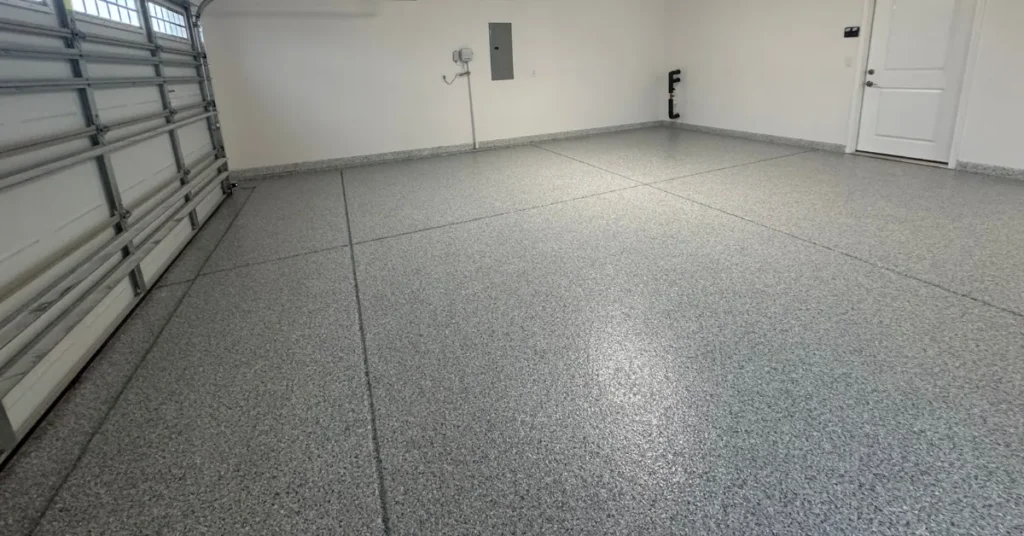
Once the floor is done, you should be able to walk it end to end and not see a single seam, line, roller mark, or inconsistency. That is the standard. That is what separates a top-tier crew from an average one.
Things you should be able to see and verify on a finished floor:
- Uniform flake coverage across the entire surface with no thin or patchy spots
- A glass-smooth top coat with zero roller marks or texture inconsistency
- Crisp, clean edges where the floor meets walls, columns, and doorways
- No coating bleed onto driveways, baseboards, or surrounding surfaces
- A floor that looks identical from the front of the garage to the back
If anything looks off, document it before final payment. A reputable contractor will fix issues. The unreliable ones will dodge calls.
Why Local Matters in Charlotte and the Surrounding Area
Charlotte has its own climate, its own housing stock, and its own concrete conditions. Older neighborhoods around Mint Hill, Belmont, and Huntersville have slabs that vary widely in age, hardness, and moisture content. Newer construction in Waxhaw and Harrisburg often has tighter, harder concrete that requires different diamond configurations during prep.
A local contractor has installed in your neighborhood. They have ground slabs poured by the same builders. They have dealt with the same humidity windows in summer and the same temperature swings in winter. They are not reading a manual. They are running on direct experience with the same conditions you have in your garage.
A local crew is also accountable. They are not driving past your house every day pretending they did not install your floor. They want referrals, they want repeat work, and they have to stand behind every project to keep their reputation in this market.
Why D&D Concrete Coatings Stands Out in This Market
D&D Concrete Coatings specializes in decorative vinyl flake garage floor systems for homeowners and businesses across Charlotte, NC, and the surrounding area. The system is built around exactly the standards covered above.
Every project starts with a commercial-grade diamond grind and full surface prep. A high-performance epoxy or polyurea base coat is selected based on the slab and the environment. Vinyl flake is broadcast to full coverage, every time, with no thin spots or patchy broadcasts. The system is sealed with a UV-stable, scratch-resistant polyaspartic top coat that delivers the high-gloss finish without ambering or chalking over time.
David Shindledecker personally manages every garage floor installation. You work directly with the expert, not a crew supervisor or a subcontractor. Every flake garage floor comes backed by a comprehensive 10-year warranty and complete project documentation.
That is what a real epoxy flooring company looks like. The right materials, the right prep, owner-level supervision, and a warranty that backs it.
For details on the system, project photos, and the use cases this floor is built for, the flake garage floor service page walks through everything you get when D&D installs a floor for you.
FAQ’s
How long should an epoxy garage floor last in Charlotte?
A professionally installed flake system with a quality base coat and a polyaspartic top coat will hold up for many years when properly maintained. D&D Concrete Coatings backs every flake garage floor with a 10-year warranty, which is the industry standard for confidence in materials and installation.
Why are some epoxy contractor quotes so much cheaper than others?
Cheaper quotes usually mean cut corners. Skipped prep, no moisture testing, lower-grade products, faster crews working past their chemical window, or thin flake broadcasts. The savings up front turn into a failing floor within a year or two. A quality install reflects the actual cost of materials, equipment, prep, and skilled labor.
Should I worry about working with a one-year-old company versus a ten-year-old company?
Years in business matters less than verifiable work and process discipline. A newer company run by an experienced installer who personally supervises every job can produce a better result than an older company that subcontracts and chases volume. Ask to see recent projects, ask about the crew, and ask what their personal role on your job will be.
Is the cheapest epoxy flooring contractor near me ever the right choice?
Almost never. The cheapest quote in any market is usually a sign that the contractor is skipping critical steps, using inferior materials, or planning to disappear before warranty issues come up. Aim for the most professional crew at a fair price, not the lowest number on the page.
Do I need to be home during the installation?
You do not need to be present, but most homeowners prefer to be available at the start to walk through the project with the installer. D&D Concrete Coatings includes owner-supervised installation as standard, so the lead on your project is also the person you have been talking to from the first estimate.
What should I do to prep the area before the crew arrives?
Clear all items off the floor at least 12 hours prior. Remove tables, chairs, rugs, and vehicles. Take down anything dust-sensitive. Keep walls clear two feet above the floor for equipment clearance. Do not park vehicles on the slab the night before installation.