You have probably heard the term “epoxy flooring” thrown around in garage forums, contractor ads, and big-box store displays. Maybe a neighbor just got their garage done and you are wondering what kind of floor they actually have. Maybe you are tired of looking at a stained, cracked, dust-shedding slab every time you pull into your garage in Charlotte.
Epoxy flooring is one of the most misunderstood products in the home improvement world. Most online articles oversimplify it. Some contractors push it as the ultimate solution. Others trash it and try to upsell you on something else. The truth sits in the middle, and once you understand how it actually works, you will know exactly what to ask for.
This guide breaks down what epoxy flooring really is, how it behaves on your concrete, where it works best, and what a complete professional system actually looks like. By the time you finish reading, you will be in a stronger position than 95% of homeowners shopping for this product.
What Epoxy Flooring Actually Is
Epoxy is a thick, two-component coating that bonds deeply with concrete. It is a commercial-grade product used in industrial plants, hospitals, warehouses, and now widely in residential garages, basements, and workshops.
When the two components are mixed, a chemical reaction begins. The mixed product is poured or rolled onto the prepared concrete surface, where it slowly cures into a hard, durable layer. Because epoxy cures slowly, it has time to penetrate deep into the pores of the concrete. That is what creates such an exceptionally strong bond.
Epoxy is also thicker than other coatings like polyaspartic. The extra thickness contributes to its strength and durability. Most epoxy formulations also include a built-in moisture barrier, which makes it more tolerant of slabs with some moisture present without requiring an extra prep layer.
Here is the part most articles get wrong. Epoxy by itself is not the finished floor you want in your garage. Epoxy alone, exposed to UV light, will yellow and amber over time. It is also not the most scratch-resistant material on the market. That is why a professional flake floor system uses epoxy as a base coat, not as the entire floor.
Why Charlotte Homeowners Are Asking About Epoxy Flooring
The functional problems with bare concrete are the same in every garage across Charlotte, Mint Hill, Huntersville, Harrisburg, Belmont, and Waxhaw. Concrete dusts. It stains. It cracks. Hot tires lift cheap paint right off the slab. Oil spills soak in and never come out. Basement slabs hold moisture and grow mildew. Pool decks chip and chalk under the Carolina sun.
A bare slab is essentially a sponge with a hard surface. It absorbs everything you spill on it. It releases dust into your space. It pits and cracks under freeze events and daily wear. After a few years, the floor that looked acceptable when the house was new looks tired, dirty, and beat up.
That is what is driving the demand for epoxy and concrete coating systems. Homeowners want a floor that performs. They want one that handles hot tires, oil spills, dropped tools, and the daily grind without showing wear. They want a surface they can hose down and walk away from. The right epoxy-based flake system delivers exactly that.
How a Professional Epoxy Flake System Works
A professional concrete coating installation is not a single product. It is a system. Every layer has a job, and the order matters. Here is what a real flake garage floor installation actually involves.
Step 1: Surface Preparation
The slab is profiled with a commercial-grade diamond grinder. The grinder opens the concrete pores and removes contaminants like sealers, paint, oil residue, and surface laitance. Before grinding, a hardness test determines what diamond configuration to use. Cracks, joints, and pitted areas are repaired with 100% solids filler.
Surface preparation is where most coating jobs succeed or fail. Improper prep is one of the leading causes of coating failure. A floor that is not properly profiled will not bond and will peel or delaminate within months.
Step 2: Moisture Testing
Before the base coat goes down, a moisture test measures the slab’s moisture levels. This determines whether the chosen base coat has enough built-in moisture tolerance, or whether a separate moisture vapor barrier needs to be installed first. Skipping this test is one of the fastest ways to end up with a peeling floor a year later.
Step 3: Base Coat Application
The base coat is what bonds to your concrete. For a garage in Charlotte, that base coat is typically epoxy because of its superior bond strength and built-in moisture tolerance. In some installations, polyurea is used as the base coat instead. Both are commercial-grade products that adhere chemically to the slab.
Step 4: Full Flake Broadcast
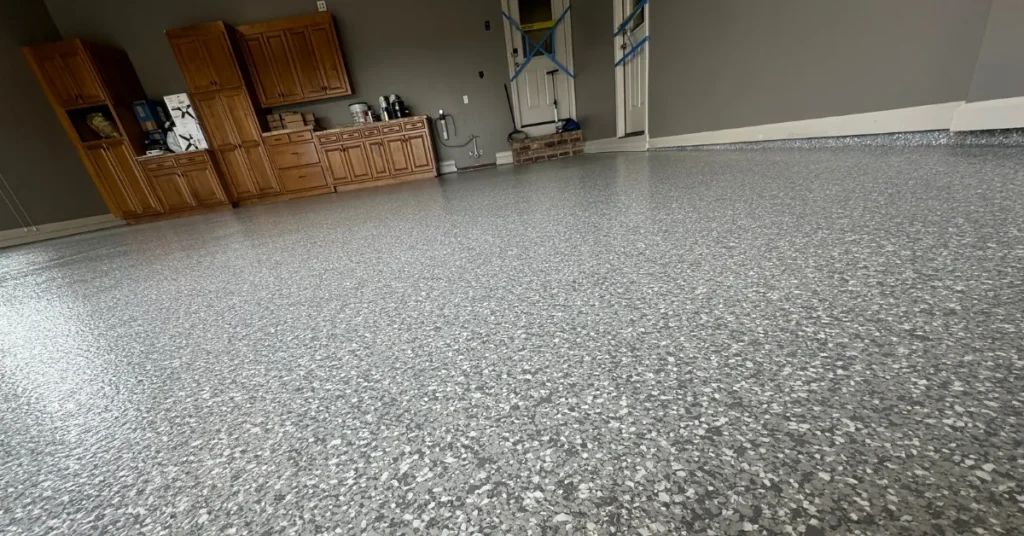
While the base coat is still wet, decorative vinyl flakes are hand-broadcast across the entire surface. A professional crew broadcasts to full coverage, which means flakes are thrown in volumes that fully cover the base coat with no thin or patchy spots. Inconsistent flake coverage is one of the easiest signs of an amateur installation.
Step 5: Excess Flake Removal
Once the base coat cures, all loose and excess flake is scraped, blown, and vacuumed off. What remains is a clean, embedded flake pattern locked into the cured base coat.
Step 6: Polyaspartic Top Coat
The top coat is what you actually walk on, drive on, and see. For flake systems, the top coat is always a polyaspartic. Polyaspartic is UV-stable, scratch-resistant, and fast-curing. It seals the flake into the system and gives the floor its glossy, finished look. This is what protects the floor from yellowing, scratching, and the daily abuse of garage life.
A floor built this way is not paint. It is not a kit. It is a chemically bonded, multi-layer commercial system installed by people who have done it hundreds of times.
Why a System Beats a Kit Every Time
Walk into any home improvement store and you will find epoxy garage floor kits for a few hundred dollars. They look like a cheap shortcut to the same result. They are not.
DIY kits use water-based or low-solids epoxy designed for someone with no prep equipment and no experience. There is no diamond grinding included. There is no moisture testing. There is no professional-grade base coat or polyaspartic top coat. Most kits skip the broadcast step entirely or include a small bag of flake that gets sprinkled on for decoration.
The result is a thin, painted-looking surface that lifts under hot tires within the first summer, peels at edges, and starts looking worse than the bare concrete it was supposed to fix. Then you are paying twice. Once for the failed kit, and again to remove it before a professional crew can install a real system.
A real epoxy flake system, professionally installed, gives you a floor that holds up for a decade and beyond. That is the gap between a kit and a system. They are not the same product, and they do not deliver the same outcome.
Where Epoxy Flake Systems Work Best
These floors are commercial-grade products being installed in residential spaces, which is exactly why they perform the way they do. Here is where they shine.
- Residential Garages. The most common application. Transforms a stained, dusty slab into a clean, easy-to-clean surface that handles hot tires, fluid leaks, and daily traffic.
- Workshops and Man Caves. Slip-resistant texture from the flake broadcast holds up under tool drops, foot traffic, and fluid exposure without showing wear.
- Attached and Detached Garages. Compatible with any garage configuration. The coating bonds directly to the existing concrete without needing replacement or resurfacing.
- Basements. A flake system seals the slab and stops the dust, moisture, and musty smell that plain concrete basements produce. Turns the basement into a functional, finished-feeling space.
- Patios and Pool Decks. Outdoor applications use a different system configuration since UV exposure changes which base coat is appropriate. A polyaspartic-based system handles the Carolina sun without ambering.
- Driveways. Coated driveways resist the constant heat, weight, and chemical exposure that wear plain concrete down faster than most homeowners realize.
- Commercial and Light Industrial Bays. A professional appearance with the durability to handle vehicle traffic, chemical exposure, and heavy commercial use.
What Separates a Professional Installation from an Amateur One
This is where most homeowners get burned. The product is only part of the equation. The crew, the prep, and the execution determine whether you end up with a floor that lasts ten years or one that fails in six months.
A professional installation is one where the homeowner cannot see a single seam, line, roller mark, or inconsistency anywhere on the floor. That level of uniformity is what separates an elite crew from a cheap one.
Things to look for in a quality install:
- Uniform flake coverage across the entire floor with no thin spots or bare areas
- A perfectly smooth top coat with zero roller marks
- Crisp, clean edges where the floor meets walls and door frames
- No coating bleed onto driveways, walls, or surrounding surfaces
- A floor that looks identical from one end to the other with no visible section lines
Cheap crews skip prep, rush base coat application, broadcast flake unevenly, and apply top coat with poor technique. The result is a floor that looks decent for a few months and tired within a year. A professional installation looks like the day it was completed five and ten years later.
Why D&D Concrete Coatings Is the Charlotte Choice
D&D Concrete Coatings specializes in decorative vinyl flake garage floor systems for homeowners and businesses across Charlotte, NC, and the surrounding area. The system is built for performance.
A high-performance epoxy or polyurea base coat. Full-coverage vinyl flake broadcast. A crystal-clear polyaspartic top coat that cures fast and holds up under real-world conditions. The full installation completed in a single day, with vehicles back on the floor within 75 hours.
Every project is owner-supervised by David Shindledecker, from the first surface prep step through final inspection. You are working directly with the person responsible for the install, not a crew supervisor or subcontractor. Every flake garage floor is backed by a 10-year warranty.
That combination of materials, hands-on supervision, and warranty protection is what a real epoxy flooring company looks like in this market.
For homeowners who want to see system specifics and use cases in detail, the flake garage floor service page walks through exactly what you get when D&D installs a floor for you.
FAQ’s
Is epoxy flooring the same as a flake garage floor?
Not exactly. Epoxy is one of the materials used in a flake garage floor system, typically as the base coat. A complete flake floor system also includes vinyl color flakes broadcast across the wet base coat and a polyaspartic top coat that seals and protects everything. When people say epoxy flooring they are usually talking about this full system rather than epoxy alone.
How long does an epoxy flake floor last in Charlotte?
A professionally installed system using a quality epoxy or polyurea base coat with a polyaspartic top coat will hold up for many years when properly maintained. D&D Concrete Coatings backs every flake garage floor with a 10-year warranty, which reflects confidence in both the materials and the installation process.
Can my garage really be done in one day?
Yes. Modern coating products and an experienced crew make one-day installations fully viable. Walk-on time is typically 24 hours after completion, and vehicles can return to the floor within 75 hours. One-day systems have proven to hold up for years and still look new.
Will the coating peel or delaminate over time?
Properly installed and properly prepped, no. Peeling and delamination almost always trace back to skipped surface prep, missed moisture testing, or inferior products. A diamond-ground slab, a moisture-tested base coat, and a chemically bonded system from D&D will not peel under normal use.
Is an epoxy floor slippery when wet?
The flake broadcast in a complete system creates a natural texture underfoot that adds traction. The texture provides slip resistance even in wet conditions, which is why flake systems are commonly installed in garages, basements, and pool decks where moisture is part of the environment.
How do I maintain a flake floor after installation?
Maintenance is simple. Sweep regularly or rinse with water for light dirt. For oil, grease, or mud, use Simple Green, Pine-Sol, Dawn, or a similar mild cleaner. Avoid battery acids and highly corrosive chemicals. The polyaspartic top coat does the heavy lifting and most spills come right off.