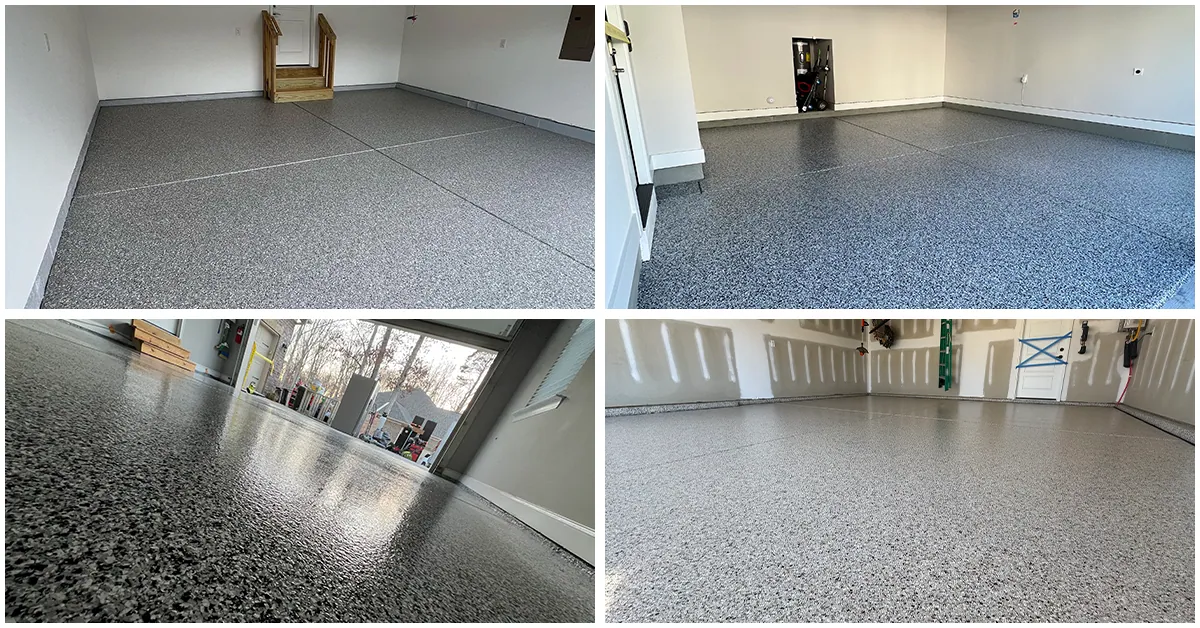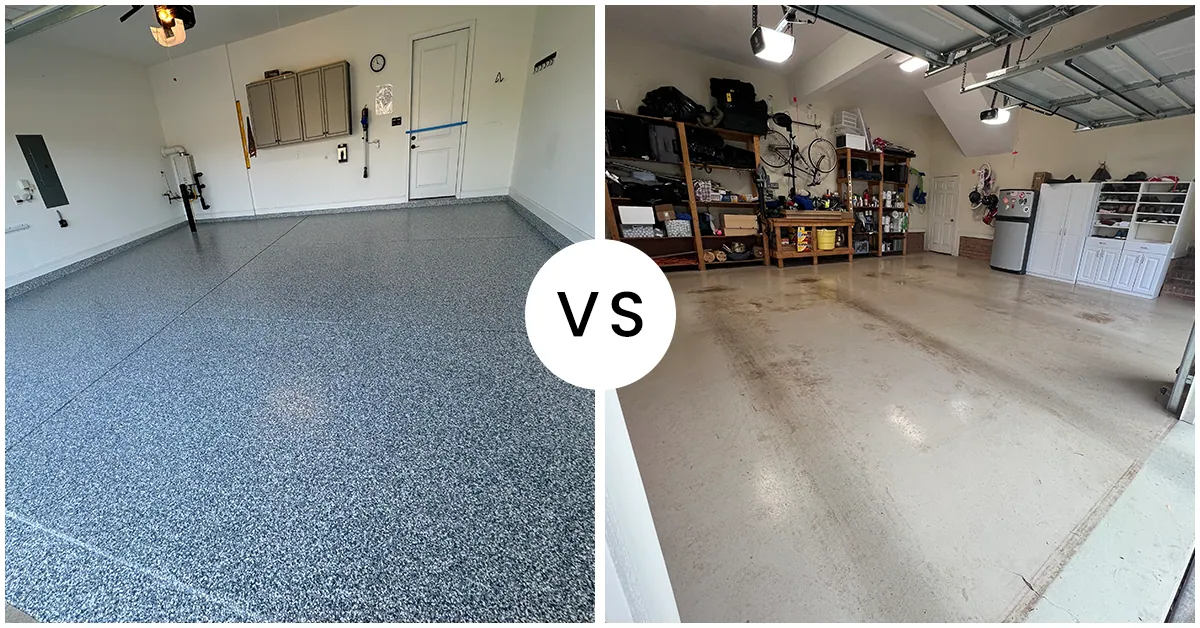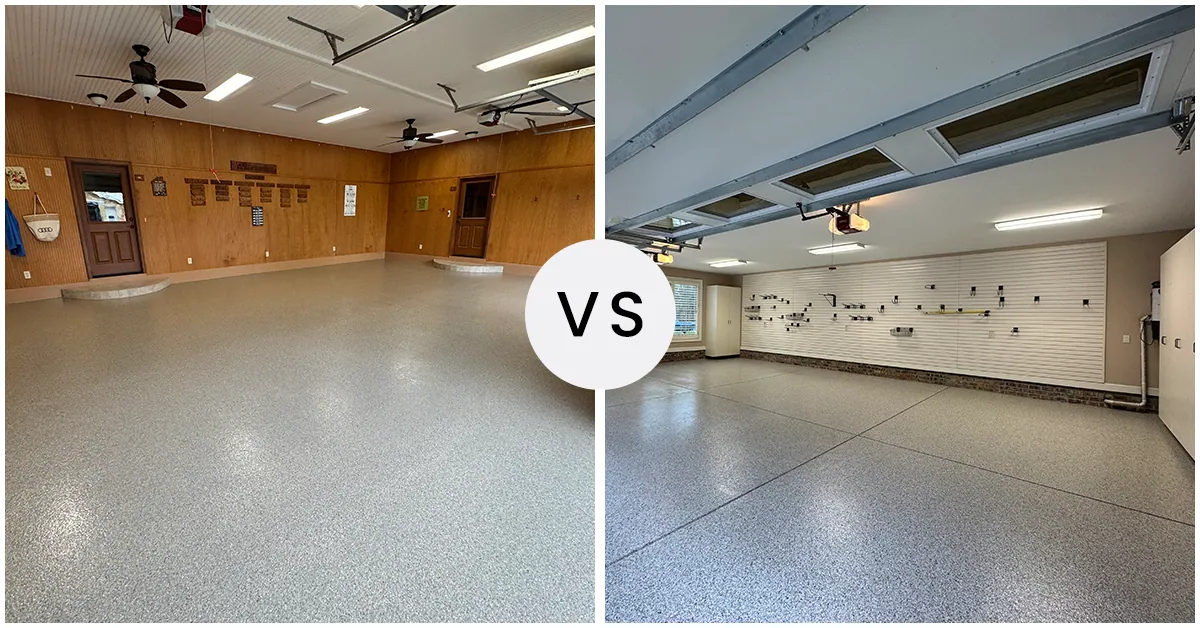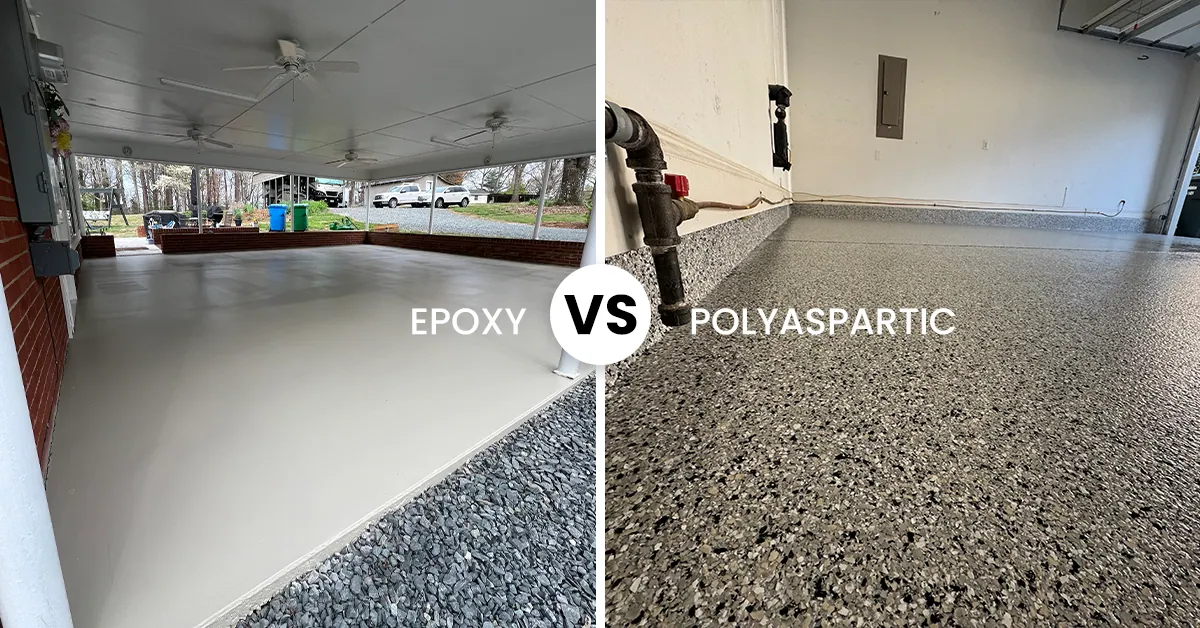
Epoxy and polyaspartic are not really competitors, they are two layers of the same system. For an indoor garage, the best build is an epoxy base coat sealed with a polyaspartic top coat, with color flake broadcast in between. Epoxy makes the best base because it bonds hardest to the concrete and tolerates moisture better than the alternatives, and indoors its one real weakness, yellowing under direct sun, never comes into play because the top coat covers it. Polyaspartic makes the best top coat because it is the most UV stable and the most scratch resistant, and it cures fast. Some companies use polyaspartic as the base coat instead, which can make sense outdoors or when a job has to finish fast, but indoors that trades away the bond and moisture protection an epoxy base gives you. So the honest answer for a garage is not one material or the other, it is an epoxy base under a polyaspartic top, each doing what it does best.
Key takeaways
- Epoxy bonds hardest to concrete and handles moisture best, which makes it the ideal base coat for an indoor garage.
- Polyaspartic is the most UV stable and scratch resistant and cures fast, which makes it the ideal top coat.
- For a garage, the best system uses both: an epoxy base and a polyaspartic top coat.
- Polyurea is a flexible base option for cold conditions where epoxy will not cure.
- Some companies use polyaspartic as the base coat; it cures fast and suits outdoor or fast-turnaround jobs, but indoors an epoxy base bonds and resists moisture better.
After years installing these floors across the Charlotte metro area, the most common question we get is which coating is better, and the honest answer is that the question is framed wrong. The materials are not rivals. The floors that hold up combine them.
What Most Homeowners Get Wrong
The misconception is that you have to pick a side: an epoxy floor or a polyaspartic floor, as if they were two finished products competing for the same job. That framing comes from the retail world, where a kit is sold as one bucket of one material, so the choice looks like epoxy versus polyaspartic.
A professional floor does not work that way. It is built in layers, and the smart move is to use each material where its strengths matter. Epoxy goes down first because nothing bonds to concrete better or shrugs off slab moisture as well. Polyaspartic goes on top because nothing resists UV yellowing and scratching like it does. Treating them as either-or means giving up half the performance. If you are still getting your bearings on the category, start with what epoxy flooring actually is.
How Epoxy and Polyaspartic Compare
Here is what each material does, and where it belongs in a floor.
Epoxy. Epoxy forms the strongest bond to properly prepared concrete and has the best built-in moisture tolerance of the common coatings, which is exactly what you want in a base coat sitting directly on a slab. It is applied thick. Its tradeoff is that it cures slowly and ambers, or yellows, under direct UV light, which is why it is not used as the exposed top layer.
Polyaspartic. Polyaspartic is the most UV stable of the coatings, so it does not yellow in sunlight, and it is the most scratch resistant, so it stands up to traffic and tools. It also cures fast, which is part of how a floor can be finished quickly. Those two traits, fast cure and UV stability, are why some installers use polyaspartic as a base coat, especially outdoors or when a job has to turn around in a day. The tradeoff is that it is applied thinner than epoxy and does not provide a moisture barrier, so as a base it gives up the bond and moisture protection epoxy provides, which is why in a garage it belongs on top of an epoxy base rather than against the slab.
Polyurea. Polyurea is more flexible than epoxy and cures in cold temperatures where epoxy will not set, with moderate moisture tolerance. It is used as a base coat option in cold conditions and to fill cracks before coating.
Put together, the logic is simple: epoxy for the bond and the moisture barrier underneath, polyaspartic for the UV and scratch resistance on top. For moisture tolerance specifically, the order is epoxy first, then polyurea, then polyaspartic, which is the reason polyaspartic is a top coat and not a base. How those layers actually go down is covered in how an epoxy garage floor is installed.
Which System Fits Your Garage
For most garages in this climate, an epoxy base with a polyaspartic top coat and color flake is the system we install most often. An indoor garage floor never sees direct sunlight, so epoxy’s one weakness, ambering under UV, never comes into play under the top coat, and you get the best of both worlds: the hardest bond and the best moisture tolerance from the epoxy base, plus the UV stability and scratch resistance from the polyaspartic top. That is why it is the standard recommendation for a working garage.
A few conditions change the base coat. In cold-weather installs where epoxy will not cure, a polyurea base takes its place under the same polyaspartic top coat. Outdoors or on heavily sun-exposed slabs, where direct sun and fast turnaround matter more, some installers reach for a polyaspartic base because it cures fast and handles UV well; that is the situation a polyaspartic base is built for. This is worth understanding, because some companies use a polyaspartic base coat on indoor garages too, sometimes pitched in place of an epoxy base. Indoors that is the weaker choice: you give up the bond and the moisture barrier an epoxy base provides in exchange for sun resistance that a covered garage floor does not need. The finish you choose, standard flake or a metallic, is a look-and-budget decision on top of the system, and the price difference between them is covered in what an epoxy garage floor costs.
What you generally should not choose for a garage is a single-layer floor that skips one of the two jobs. An all-epoxy floor with no polyaspartic top will amber and scratch sooner. A thin polyaspartic-only floor over bare concrete gives up the bond and moisture protection of an epoxy base. The system exists because each layer covers the other’s weakness, and indoors that means epoxy underneath and polyaspartic on top.
What Happens When You Get This Wrong
Picking the wrong system, or a single-product version of it, shows up over time. An all-epoxy floor in a sunlit garage yellows and loses its finish. A thin coating with no real base bonds poorly and can peel. A floor installed in cold weather with a material that never fully cured stays soft and fails early.
The consequences are the same as any failed coating: the floor has to be ground off and rebuilt, so the shortcut costs more than doing it right the first time. Matching the system to the slab and the climate is what determines how long the floor lasts, and it is a decision made before the first coat goes down.
Why How a Contractor Builds the System Matters
Most coating sales pitches lead with a single product name, epoxy or polyaspartic, because it is simpler to sell. The contractors worth trusting talk about the system: which material goes where, and why it suits your slab and your climate.
A contractor who builds the system right tests the slab for moisture and temperature before choosing a base coat, uses an epoxy base where conditions allow and a polyurea base where they do not, broadcasts flake to full coverage, and seals everything with a polyaspartic top coat for UV and scratch resistance. That is what an epoxy garage floor coating system is, a matched build rather than one product stretched to do every job. We build it that way because the floor is only as good as the weakest layer, and using each material for its strength is what keeps the whole system intact.
The Bottom Line
The epoxy versus polyaspartic question has a better answer than picking one: use both, each where it belongs. Epoxy for the bond and moisture barrier underneath, polyaspartic for the UV and scratch resistance on top, flake in between for traction and looks. That combined system is the best garage floor coating for most homes, and matching it to your slab and climate is what makes it last. If you want a system specified for your garage rather than a one-product pitch, request a free in-person estimate and we will recommend the right build.
Frequently Asked Questions
Is polyaspartic better than epoxy for a garage floor?
Neither is better on its own, because they do different jobs. Epoxy bonds best to concrete and resists moisture, so it belongs underneath as the base. Polyaspartic resists UV and scratches and cures fast, so it belongs on top. The best floor uses both rather than choosing between them.
What is the best coating for a garage floor?
For most garages, an epoxy base with color flake and a polyaspartic top coat is the best coating, because it combines the strongest bond and a moisture barrier with UV and scratch resistance. In cold conditions a polyurea base may replace the epoxy under the same top coat.
Can you put polyaspartic over epoxy?
Yes, and that is exactly how a quality system is built. The epoxy base bonds to the concrete and the polyaspartic top coat seals and protects it. The two are designed to work as layers, not as competing choices.
Is epoxy better than paint or a concrete sealer for a garage?
Yes. Garage floor paint and basic sealers sit thin on the surface and wear through under traffic and hot tires, while a professional epoxy and polyaspartic system bonds into the prepared concrete and is built to last for years. Paint and sealer are surface treatments, not a coating system.
Why does an all-epoxy floor turn yellow?
Epoxy ambers under direct UV light, which is a normal property of the material. That is why it is used as the base coat and not the exposed top layer. A polyaspartic top coat, which is UV stable, prevents the yellowing you would see from epoxy left exposed.
Can polyaspartic be used as a base coat instead of epoxy?
Yes, some installers use a polyaspartic base because it cures fast and is UV stable, which can suit outdoor slabs or jobs that have to finish in a day. For an indoor garage, though, an epoxy base bonds harder to the concrete and gives better moisture tolerance, and the floor never sees direct sun under the top coat, so the stronger build is an epoxy base with a polyaspartic top.