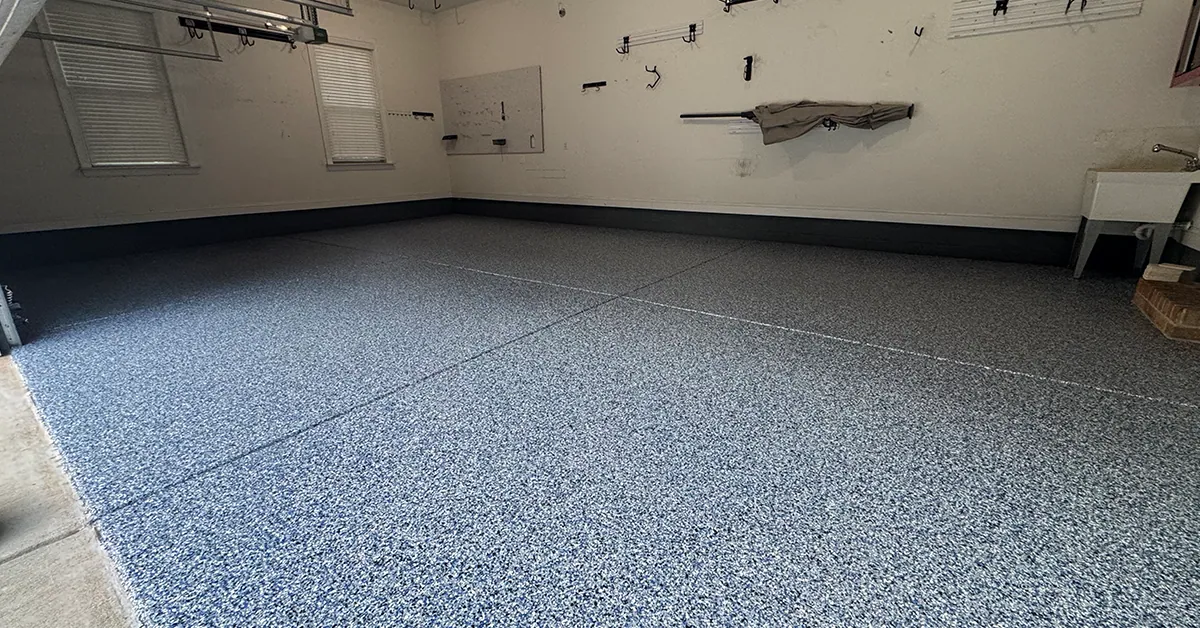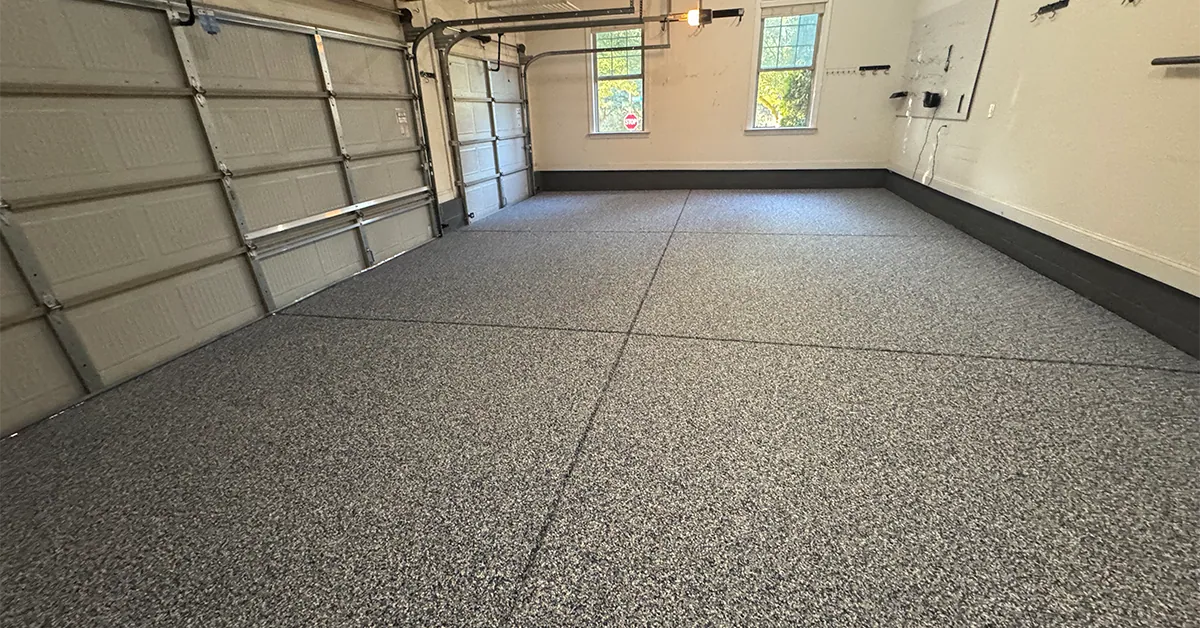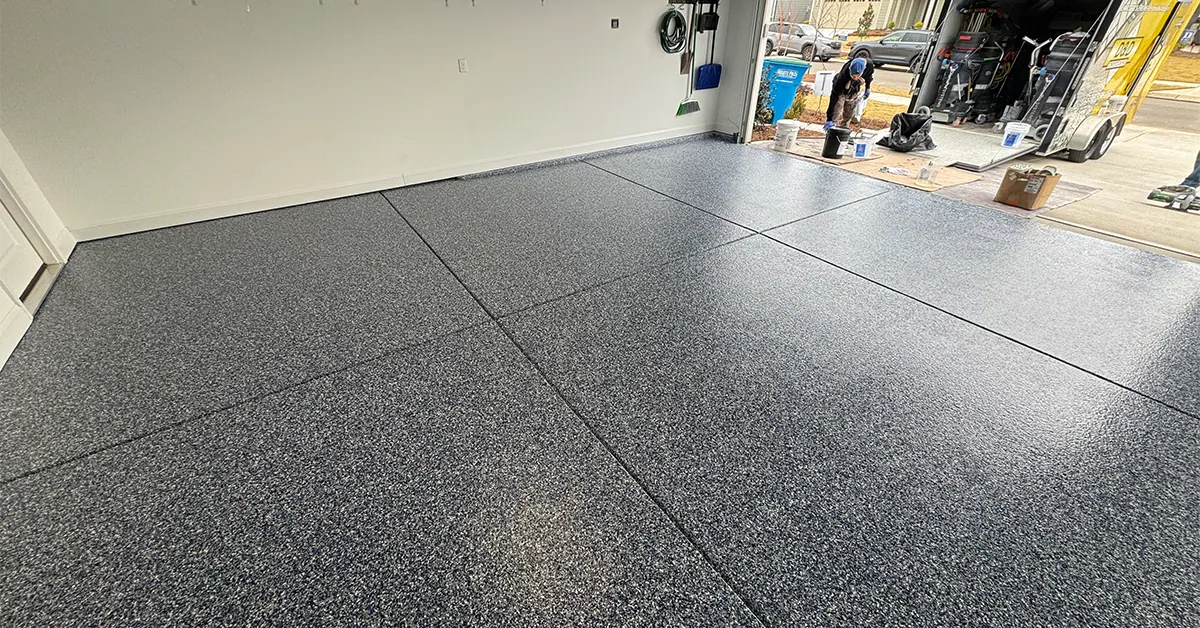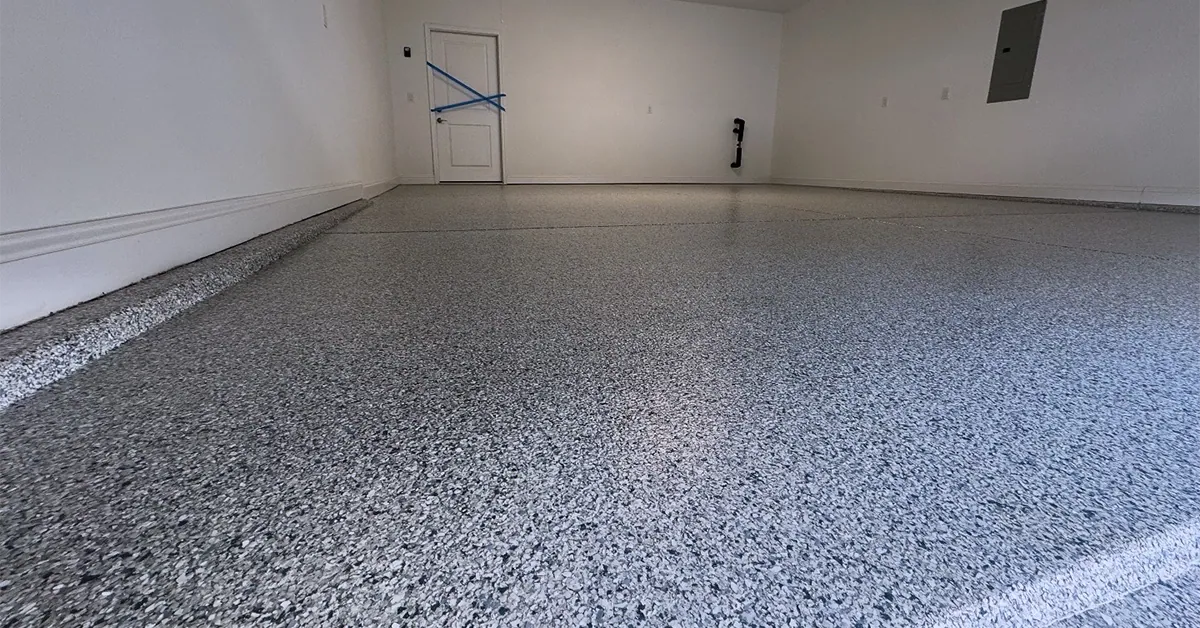
Epoxy flooring, also called an epoxy floor coating, is a professionally installed system that bonds chemically to concrete to create a hard, sealed, easy-to-clean surface. What most people call epoxy flooring is actually a multi-layer system: an epoxy or polyurea base coat, a full broadcast of decorative vinyl flake, and a UV-stable polyaspartic top coat. It is a commercial-grade approach now widely installed as epoxy garage floors across the Carolinas. The key point is that a real epoxy floor is a system, not a single product or a can of paint.
What Most Homeowners Get Wrong
After years installing these floors across the Charlotte metro area, the thing we end up explaining on nearly every estimate is this: the “epoxy” in a hardware-store bucket is not the product we put down. The most common misconception is that “epoxy” is one thing you brush onto a floor, like a thicker paint. It is not, in two ways. First, epoxy is a two-part material: a resin (Part A) and a hardener (Part B) that are mixed on site and cure through a chemical reaction into a hard, bonded surface. Paint simply dries as its solvent evaporates; epoxy chemically reacts and hardens, which is the difference between a coating that sits on top and one that becomes part of the floor.
Second, epoxy is only one component in the finished product. The thing people picture as an epoxy floor is really a layered system, and the epoxy is just the base layer of it. That is why a boxed “epoxy kit” from a big-box store is not the same thing a contractor installs: the kit is a single product, while a professional floor is several materials working together.
There is one more layer to this: not all epoxy is even the same epoxy. Epoxy is sold in different formulations, measured by solids content, which is the share of the product that stays behind as cured film instead of evaporating off. Professional-grade epoxies are high-solids, up to 100% solids, where almost nothing evaporates and nearly all of what is applied becomes the finished floor. Big-box kits are often water-based or low-solids, so a large part of the can flashes off and leaves a thin film. Two products both labeled “epoxy” can be very different as a result.
What an Epoxy Floor Is Made Of
A complete epoxy floor is built from three layers, and naming them is the fastest way to understand what the system actually is.
- Base coat (the foundation). An epoxy or polyurea layer that bonds to the concrete and anchors everything above it. Epoxy handles a damp slab better than the other coatings, which is why it is the usual choice indoors.
- Vinyl flake (the body and the look). Decorative color flake that gives the floor its finished appearance, its texture, and added thickness.
- Polyaspartic top coat (the seal). A clear, scratch-resistant layer that seals the system and is the surface you actually walk and drive on. It stays clear in sunlight instead of yellowing, what the trade calls UV-stable.
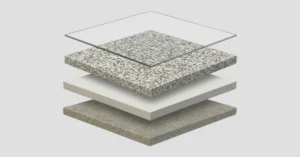
How those three layers are applied, step by step, is a topic of its own. If you want the full process, how a floor is installed walks through it. For understanding what epoxy is, the point is simply that the three layers each do a distinct job, and the floor only performs when all three are present.
The Different Types of Epoxy Flooring
An epoxy floor coating is not one fixed look but a category. The same family of materials produces a few distinct finishes:
- Flake systems, the standard for residential garages, using a full broadcast of vinyl color flake.
- Metallic systems, which use pigmented resin to create a marbled, reflective finish.
- Solid-color systems, which skip the flake for a uniform color.
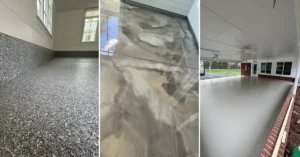
It is also not only a garage product. Epoxy flooring for homes can go in basements, workshops, and patios too, and the same systems are installed in commercial spaces, with the base coat matched to the moisture and use of each. For now, the point is just that epoxy floors come in more than one form.
What Happens When You Get This Wrong
Treating a kit as the same thing as a professional system has one practical cost: you buy on the word “epoxy” alone and end up with the wrong product. A low-solids, consumer-grade kit dries to a thin film, and a thin film is what wears through, scuffs, and lifts under the weight and heat of daily garage use, often within a season or two. Many kits also leave out the parts that make a floor last, with no separate UV-stable top coat to take the abuse and stay clear, so the surface yellows and chalks. You paid for something labeled epoxy and got a fraction of the system.
The cost is not only the failed floor. Once a coat fails it has to come off before a better one can go down, so the cheapest product becomes the most expensive route to the floor you actually wanted. What a kit is really being measured against is a professional flake garage floor system built from commercial-grade, high-solids materials, which is what the word “epoxy” on the box was borrowing its credibility from in the first place.
The Bottom Line
Epoxy flooring is not a product you paint on. It is a layered, professionally installed system, a chemically curing base coat, a flake layer, and a polyaspartic top coat, that turns bare concrete into a sealed, finished surface. Knowing it is a system, and not a can of paint or a kit, is the single most useful thing to understand before you start comparing options. Once that is clear, the next question is who you trust to install it well, which is its own subject: how to choose an epoxy flooring contractor. If you are weighing an epoxy floor for your garage or another space, the most useful next step is a free in-person look at your slab, which is how we start every project.
Thinking about an epoxy floor? We build every quote around your actual slab, and David walks the estimate himself. Get a free in-person estimate
Frequently Asked Questions
Is epoxy flooring the same as a flake garage floor?
Not exactly. Epoxy is one material in the system, usually the base coat. A flake garage floor is the complete system: an epoxy or polyurea base coat, a full vinyl flake broadcast, and a polyaspartic top coat. When people say epoxy flooring, they usually mean this full system.
What is the difference between epoxy floors and epoxy floor paint?
True epoxy is a two-part material, a resin and a hardener, that cures through a chemical reaction into a hard bonded surface. Epoxy floor paint, often sold as a DIY kit, is a thin product that mostly dries rather than chemically curing, with no flake broadcast and no polyaspartic top coat, so it is a different product class.
What is metallic epoxy flooring?
Metallic epoxy flooring uses pigmented resin to create a marbled, reflective finish instead of a flake broadcast. It is a different look within the same professional category, more common in showrooms and living spaces than in working garages.
Is epoxy flooring only for garages?
No. The same systems are installed in basements, workshops, patios, and commercial floors. The base coat is matched to the moisture and use of each space, so epoxy floors are best understood as a category rather than a single garage product.
Is epoxy the same as a concrete sealer?
No. A concrete sealer soaks into or thinly coats the slab to resist moisture and dust, but it adds no color, thickness, or flake. An epoxy system is a built-up, multi-layer floor with a decorative and protective surface.
Can I install epoxy flooring myself?
DIY kits exist, but they are a different product class from a professional installation, which uses commercial-grade base and top coats and equipment a kit does not include. How a professional floor is actually installed is covered in its own guide.
What does “solids content” mean in epoxy?
Solids content is the share of an epoxy product that remains as cured film after it sets, rather than evaporating off as water or solvent. A high-solids epoxy, up to 100% solids, leaves a full-thickness layer, while a low-solids or water-based product leaves a much thinner one. It is one of the clearest ways a professional-grade epoxy differs from a big-box kit.