Table of Contents
- What most homeowners get wrong
- Polyaspartic vs Epoxy vs Polyurea: What Each One Actually Does
- What determines which combination goes on your floor
- What happens when you get this wrong
- Why how a contractor builds the system matters
- The bottom line
- Frequently asked questions
Direct Answer
None of the three is better, because they are not competing products. They are layers in one system. Epoxy, polyurea or polyaspartic goes down as the base coat, decided by the project, bonding into the ground slab. Polyaspartic goes on top as the wear layer, taking the tires, the chemicals and the UV. A floor built correctly uses two of the three, and which base coat is selected is a conditions decision made at the estimate from the moisture reading and the temperature, not a preference.
Key Takeaways
- All three can go down as the base coat depending on the project, and polyaspartic is also the standard topcoat.
- Epoxy cures slowly and bonds deep; that slow cure is the advantage, not a drawback.
- Polyurea is the cold-weather and slab-movement base, used at temperatures where epoxy will not cure properly.
- Polyaspartic holds color and gloss under UV and resists hot-tire pickup, where a warm tire lifts the coating as it cools.
- Topcoat thickness is a specified figure rather than a judgment call: too thick and the floor gets slippery, too thin and the flake is left exposed.
A contractor who stocks all three has no reason to tell you one of them wins, which is the first thing to establish before you take a recommendation on any of them.
We install all three across the Charlotte metro and the choice is decided by the slab and the season, not by which product markets itself hardest.
What Most Homeowners Get Wrong
The market presents these three as a choice: epoxy versus polyaspartic, polyurea versus epoxy, pick a winner. Homeowners arrive having read that polyaspartic is stronger than epoxy, or that polyurea is faster, and expect to select one.
The framing is wrong because the three materials do different jobs at different depths in the same floor. Asking whether polyaspartic is better than epoxy is like asking whether a roof is better than a foundation. The confusion persists because a contractor who only installs one of them has a commercial reason to keep the comparison alive.
And there is a second reason the comparison misleads: the grade matters more than the name. Each of these three is sold at several grades. The number that separates them is how much of the product stays on the floor after it cures rather than evaporating off, and a top-grade version leaves almost all of it while a thinned retail version leaves a fraction. Two buckets can carry the same word on the label and behave like different materials, which is why what an epoxy garage floor actually is starts with the material rather than the name. The useful question is not which of the three, it is what grade of each, and who is putting it down with what equipment. A crew with an industrial grinder and a moisture meter will get more out of a mid-grade product than a crew with a rented buffer will get out of the best one.
Polyaspartic vs Epoxy vs Polyurea: What Each One Actually Does
Epoxy is a base coat. One hundred percent solid epoxy laid straight onto the ground slab, about four sheets of paper thick, 15 mils in trade terms. Its job is sticking to the concrete. It cures slowly, and that slow cure is the point: it gives the resin time to soak into the opened concrete and lock itself into the slab rather than sitting on it. It is the default base on most residential garages.
Polyurea is a base coat too. Flexible, fast-curing, and used where conditions call for it. It cures at temperatures where epoxy will not, which matters on a winter install, and its flexibility handles a slab with more seasonal movement. Below 30 degrees the base switches to polyurea as a matter of course.
Polyaspartic goes both ways. It is the standard topcoat, rolled over the flake thin enough to feel the texture through it and thick enough to lock every chip down. It also goes down as a base coat on the right project, which is why comparing it to epoxy and polyurea as though it were a third alternative misses the point: it can be the layer underneath, the layer on top, or both. It does not yellow in sunlight, so it keeps its color and shine through a Carolina summer, and it resists the hot-tire pickup that lifts thinner coatings. It is what you are actually walking and parking on.
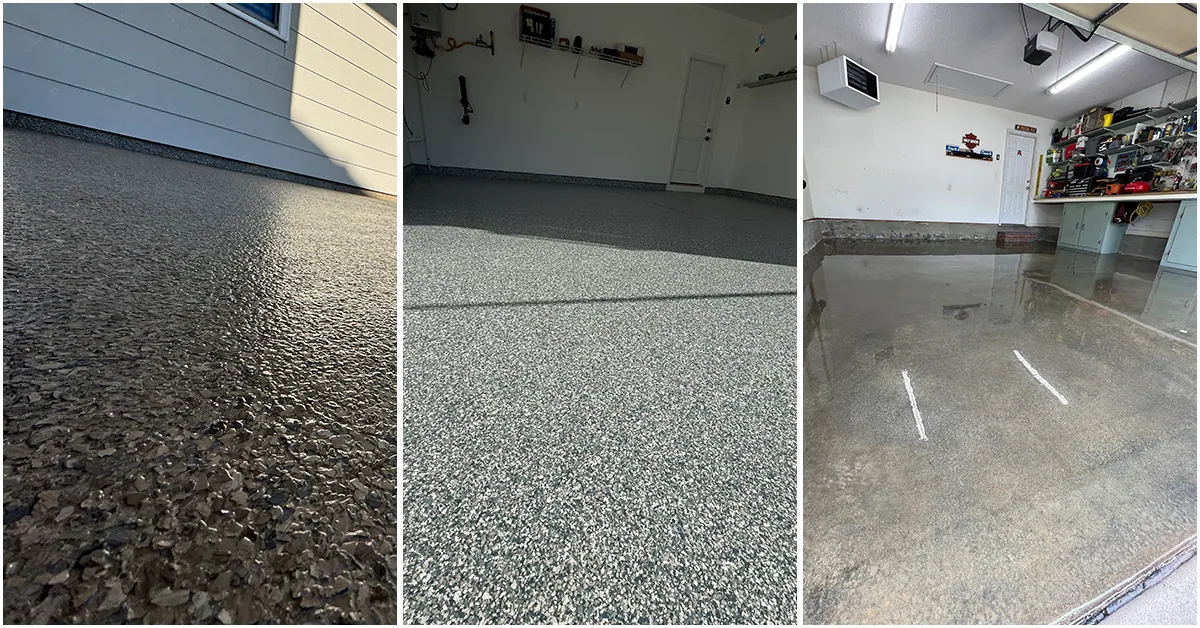
The flake sits between them. Vinyl flake broadcast into the wet base coat to full coverage, which carries the color and gives the surface the texture that keeps it from being slick when wet. A grip additive can be worked into the topcoat where extra traction is wanted.
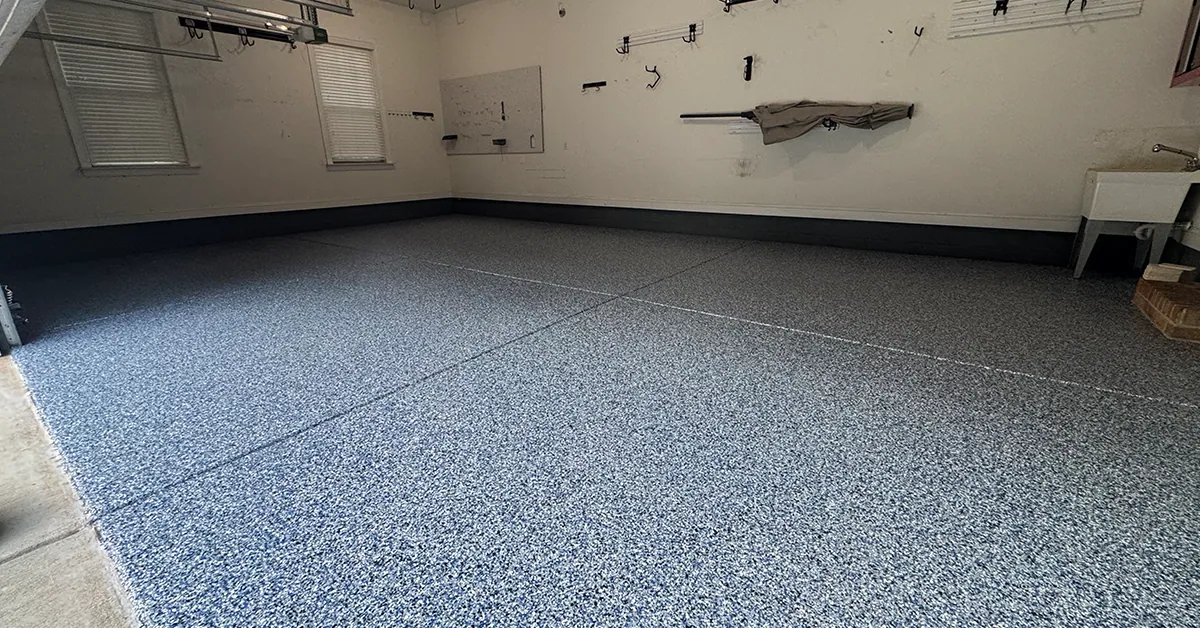
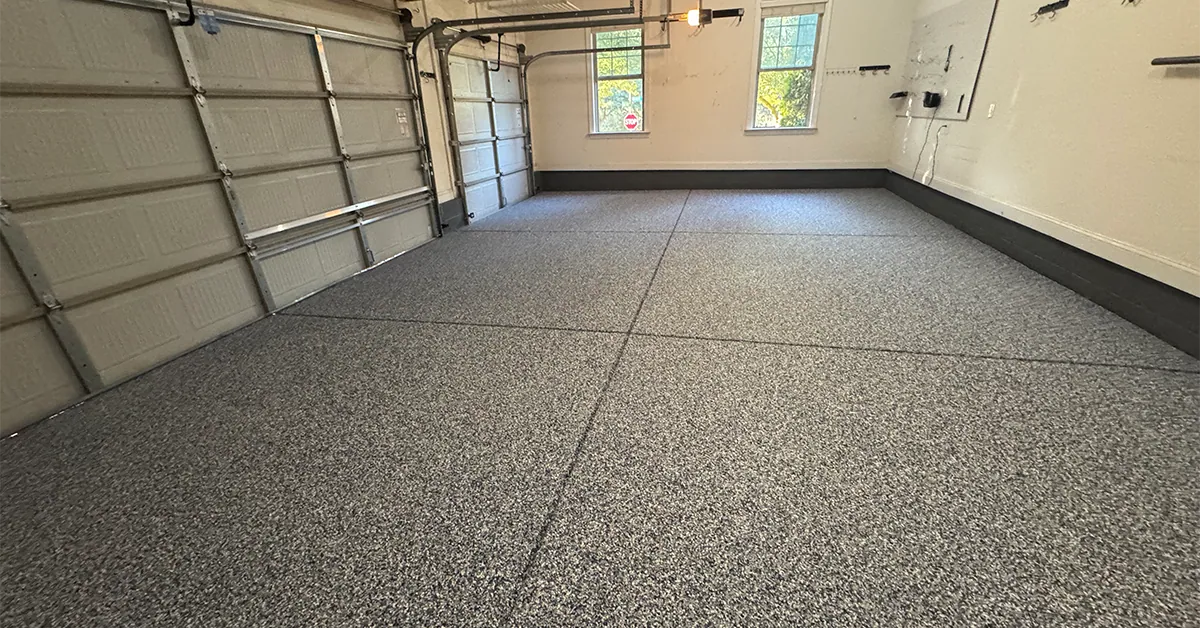
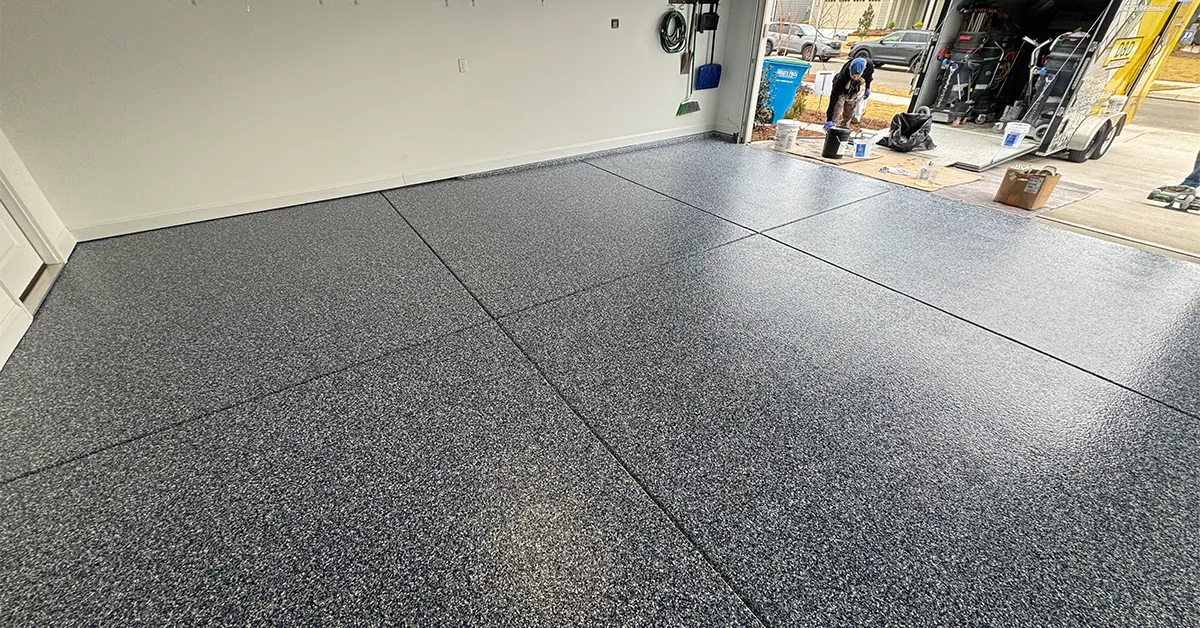
So a finished garage floor is: a properly prepared slab, the base coat the project calls for, flake until the surface will not take another chip, polyaspartic topcoat.
What Determines Which Combination Goes on Your Floor
Slab moisture. A slab that looks perfectly dry can still be passing vapor up from the ground, and a high reading changes which base coat is appropriate and can call for a moisture-barrier product, which is why the reading is taken before anything is applied.
Temperature at install. Resinous systems are not installed below 30 degrees. Below that threshold the base switches to polyurea because it cures where epoxy will not, and how an install is sequenced is built around it.
Slab movement. A slab with a history of seasonal cracking benefits from a flexible base that can accommodate movement without releasing.
How hard the concrete is. Tested first, because it tells the crew which grinding tooling to fit. This does not change the material choice but it changes whether the material can bond at all.
How the garage gets used. A floor that takes a floor jack, dropped tools or a lift is a different specification conversation than a floor that parks two cars.
Topcoat thickness is not a variable. About three sheets of paper thick, 13 mils, is the specification, and going thicker buries the flake texture while going thinner leaves flake edges exposed. A contractor offering a thicker topcoat as an upgrade is offering a slipperier floor, and why that figure is not a place to add value goes into it.
What Happens When You Get This Wrong
A polyaspartic base coat cures fast, which means less time to penetrate the slab than a slow-cure epoxy, and a shallower bond to match. That is a real trade and a legitimate one where the conditions call for it. The failure is choosing it for the schedule rather than for the slab, because a one-day turnaround sells better than a two-day one regardless of what the concrete needed.
An epoxy-only floor with no polyaspartic topcoat has no UV-stable wear layer. It ambers under sunlight and gives up its gloss, and the flake edges wear because nothing sealed in them.
Using polyurea where epoxy would have been fine is not a failure. Choosing it because it cures faster, rather than because the conditions called for it, is a scheduling decision dressed up as a technical one.
And a topcoat applied outside the 13-mil window fails in one of two directions: slippery, or worn through at the tire paths within a couple of seasons.
Why How a Contractor Builds the System Matters
A contractor who only installs one of the three has a commercial reason to frame the other two as inferior, and that is where most of the versus framing in this market comes from. It simplifies the sale and it removes the conditions conversation entirely.
A contractor who builds this properly measures before selecting. Slab moisture and temperature decide the base coat. Concrete hardness decides the grinder configuration. The topcoat is specified at a thickness with a reason behind it rather than applied until the bucket is empty. And the floor is scraped after the flake sets, before the topcoat, because flake standing vertically becomes sharp once the polyaspartic cures the surface to diamond hardness.
All three materials go in the van on our flake epoxy floors, which is why the recommendation comes from the slab. We install epoxy, polyurea and polyaspartic, which means the selection is made on your slab rather than on our inventory. In-house crews, owner-led from estimate to walk-through, and a 10-year warranty against peeling and delamination on every residential flake install.
Where a one-day polyaspartic system is genuinely the right call. If you need the garage back tomorrow and the slab is sound and dry, a fast-cure system is a reasonable trade. It is a shallower bond than a slow-cured epoxy base, and on a good slab in a garage that parks two cars, that difference may never matter to you. The trade is real and it is yours to make.
The Bottom Line
Stop comparing the three and start asking which two your slab needs. Epoxy or the base coat chosen from a moisture reading and the conditions rather than from a brochure, flake between the layers, and polyaspartic on top. A contractor who installs all three has no reason to pick a winner for you, which is the whole point. The combination your floor calls for gets decided on site, in about half an hour.