Table of Contents
- What most homeowners get wrong
- What Epoxy Flooring Is: The Layers, and the Slab They Go Onto
- What decides whether the layers hold
- What happens when you get this wrong
- The bottom line
- Frequently asked questions
Direct Answer
An epoxy garage floor is not paint. It is a bonded multi-layer coating system: the slab is mechanically ground open, an epoxy, polyurea or polyaspartic base coat goes down depending on the project, vinyl flake is broadcast into the wet base to full coverage, and a polyaspartic topcoat seals everything into one continuous surface. Each layer does a different job, and the formulations vary widely: base coats range from water-thinned retail products to 100 percent solid commercial epoxy. A professional system runs each layer to a specified thickness rather than simply to coverage. The finished floor is only as good as the bond between that first layer and the concrete.
Key Takeaways
- An epoxy garage floor is three bonded layers over one prepared slab, not a coat of paint.
- The base coat bonds; the flake gives color and texture; the polyaspartic topcoat takes the abuse.
- The bond depends on mechanical surface preparation, which is why how the slab gets prepared matters more than product choice.
- Topcoat thickness is a specification rather than a preference: too thick and the floor gets slippery, too thin and the flake is not fully sealed in. Ask any contractor what thickness they work to.
- Cure follows the install, and a contractor should give you both windows in writing before the crew leaves.
We have ground open enough Charlotte-area slabs to know that most of what fails on a garage floor was decided before any coating came out of a bucket.
We have ground off enough failed coatings across the Charlotte metro to know the floor almost never failed because of the product in the bucket.
What Most Homeowners Get Wrong
Most people shop for a garage floor the way they shop for paint. They look at colors samples, pick a blend they like, and assume the product in the bucket is what decides how long the floor lasts.
The color is the last thing that happens and it has almost nothing to do with how long the floor survives. Three things decide that, and all three are invisible by the time you see the finished floor.
The first is what went onto the concrete. Two products can both say epoxy on the label and be different materials, because epoxy is sold by solids content, which is the share of what you apply that stays behind as cured film instead of evaporating off. A 100 percent solid product leaves almost everything behind. A water-thinned retail product leaves a fraction of it, which is why the same coat of paint-thin epoxy that looks identical on day one wears through in a season.
The second is what happened to the concrete before anything went on it. The slab has to be opened mechanically so the coating has something to grip, the moisture coming up through it has to be measured, and the cracks that only appear after grinding have to be filled rather than painted over.
The third is what the crew was using. A contractor who owns an industrial grinder and a moisture meter and one who rents a floor buffer will produce different work from identical materials.
The mistake is easy to make because a floor that will fail can look every bit as good on day one as a floor that will last.
What Epoxy Flooring Is: The Layers, and the Slab They Go Onto
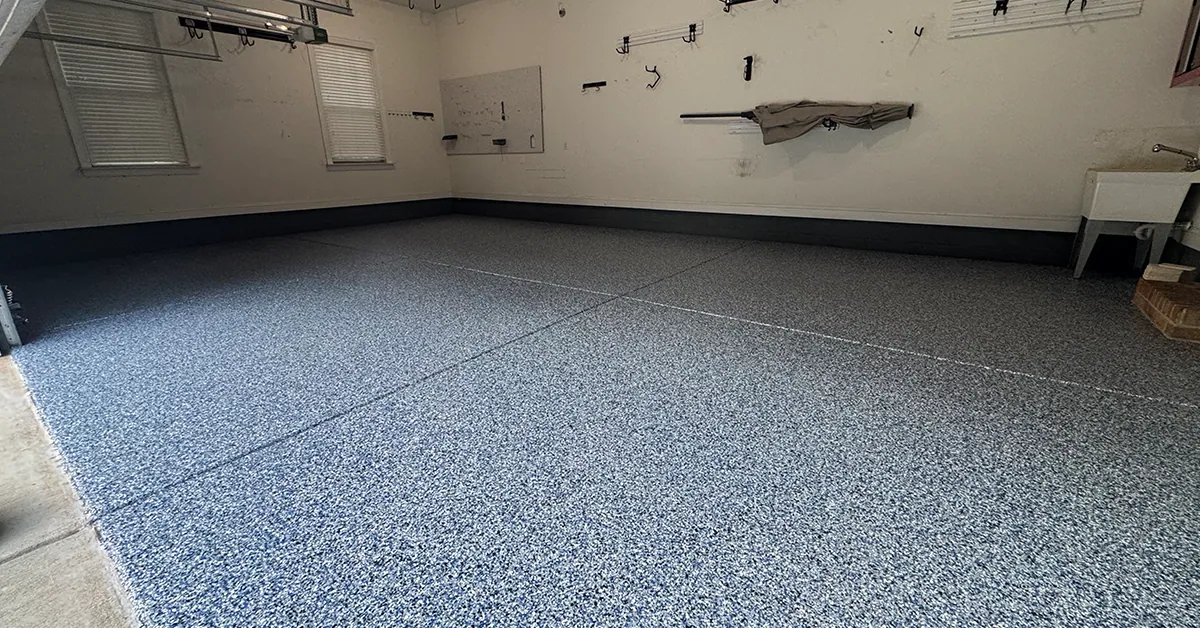
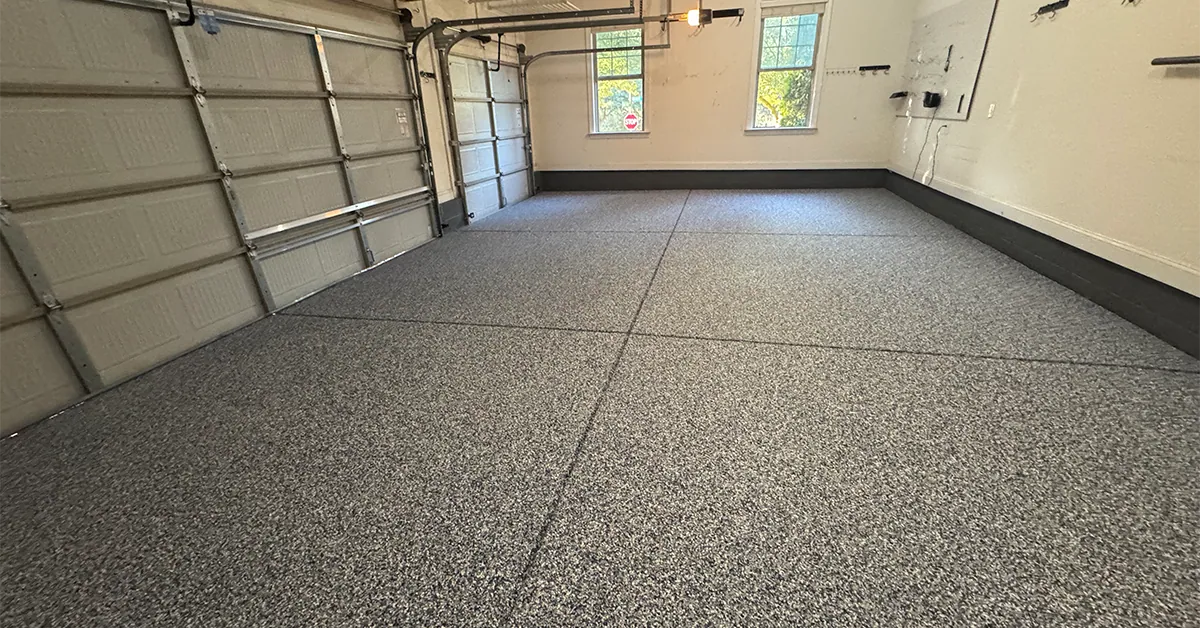
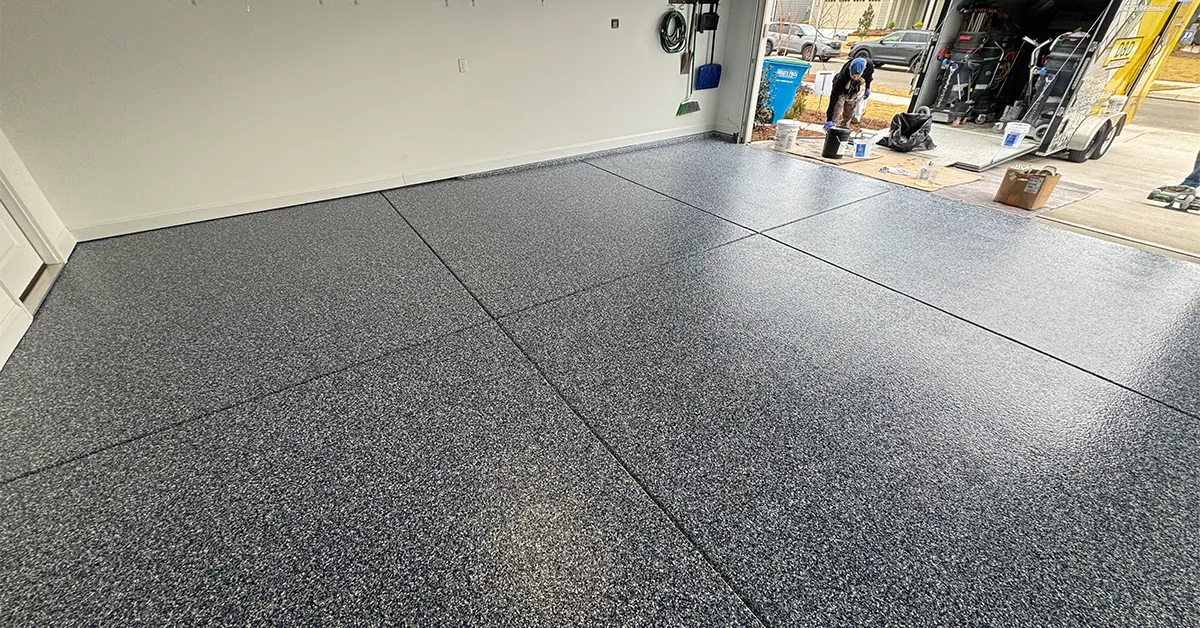
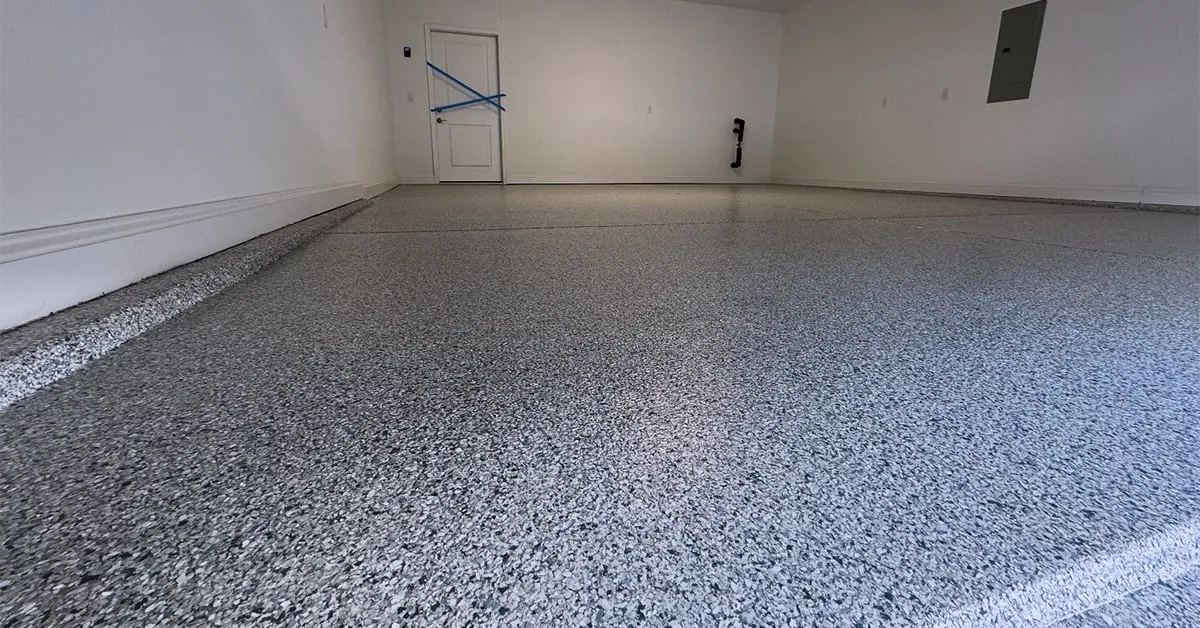
A finished epoxy garage floor is three coating layers over one prepared surface. The slab is not a layer, it is what the layers have to hold onto, and it is where most floors are won or lost.
The prepared slab, which everything else depends on. The concrete is ground with an industrial machine until the surface changes color and opens up, which you can see happening as the crew works. That opened surface is what the coating grips, the way primer grips sanded wood. How hard the concrete is gets tested first, because that decides which grinding tooling the machine needs.
The base coat. Epoxy on most residential garages, or polyurea or polyaspartic where the project calls for it, applied directly to the opened concrete. Whether it holds depends on decisions made before it goes on: whether the slab was ground rather than acid washed, whether the moisture coming up through it was measured, and whether the cracks the grinding exposed were filled or covered. Solids content is the variable worth asking about. A 100 percent solid product is a different material from the water-thinned epoxy in a retail kit, and only one of them builds real thickness. This layer is the bond. A slow-curing epoxy has the longest window to penetrate the open pores and become one with the slab; a faster-curing base has less, which is one of the trades made when conditions push the choice.
The vinyl flake. Colored chips thrown into the wet base coat until the surface will not take another one. The flake is where the color comes from, and it gives the floor the slight texture that keeps it from being slick when wet. Once it has set for a couple of hours the whole floor is scraped and vacuumed, because any chip standing on its edge would be sharp underfoot once the topcoat hardens.
The clear topcoat. A clear polyaspartic layer rolled over the flake, thin enough to feel the texture through it and thick enough to lock every chip down. This is the surface you actually walk and park on, and it is the layer taking the tires, the dropped tools, the oil and the sunlight. Thickness here is a specification rather than a preference, and it is worth asking any contractor what they apply.
A sealer, by contrast, is one thin layer that soaks in and darkens the concrete. Paint is one layer that sits on top. Neither is a system, and neither has a wear layer.
What Decides Whether the Layers Hold
The layers are only half of it. A system this good can still fail, and when it does the cause is almost never the coating. It is the slab it went onto and the conditions on the day it was installed.
Three things decide it. The first is the concrete itself: a coating cannot bond to a smooth, sealed or previously coated surface, so the slab has to be ground open first, and how a garage floor is prepared before any coating goes down is where that work happens. The second is moisture: concrete moves water vapor upward from the ground, and a slab that looks perfectly dry can still be passing enough of it to push a coating off from underneath, which is why a reading is taken before anything is chosen. The third is temperature, because these are chemical products with a cure window, and the way an install is sequenced is built around it.
None of that changes what an epoxy garage floor is. It is still the three layers. But it is the reason the same three layers can last a decade on one slab and lift within a season on another, and it is worth knowing before you compare two quotes.
What Happens When You Get This Wrong
Treating a retail kit as the same thing as a professional system has one practical cost: you buy on the word epoxy alone and get a fraction of the system. A low-solids consumer product dries to a thin film, and a thin film is what wears through and lifts under the weight and heat of daily garage use, often within a season or two. Many kits also leave out the layer that takes the abuse, with no separate UV-stable topcoat, so the surface yellows and chalks.
You paid for something labelled epoxy and got a fraction of the system. That is the failure specific to not knowing what the word covers, and it is different from the failures that come from bad installation. A floor that was installed correctly and still failed has a different set of causes, and why coatings lift off the slab covers those.
The cost is not only the failed floor. Once a coating fails it has to come off before a better one goes down, so the cheapest product becomes the most expensive route to the floor you wanted.
What a coating will not do. A coating is a finish, not a structural repair, and that limit applies to every system on the market including the epoxy garage floor coatings we install.
Why How the System Is Built Decides What You Get
Two floors can carry the same word on the label and behave like different surfaces, and the difference is decided before any color goes down. A contractor who diamond grinds the slab to a white, open, porous profile gives the base coat something to bond into. One who etches or rinses does not, and that bond is the whole floor.
We grind every slab with industrial planetary machines and hand grinders into the corners, treat every crack with two-part polyurea and silica sand before coating, broadcast flake to refusal, meaning until the wet base will not take another chip, rather than to a coverage target, and finish with a polyaspartic topcoat about three sheets of paper thick, 13 mils, which is where the daily abuse lands. David is on every job from the estimate through the final walk-through, with in-house crews rather than subcontractors, because a multi-layer system is only as good as the person accountable for each layer.
The Bottom Line
An epoxy garage floor is a bonded system, and the question worth asking is not which color but how the slab gets prepared. If the concrete is opened mechanically, tested for moisture, and repaired before coating, the finish will outlast the reason you wanted it. If it is not, the finish is temporary regardless of what went on top. If you want to know what your specific slab needs, the estimate is where that gets answered.